Exposições
"Dá-me uma gotinha de água" de Tiago Alexandre
A Galeria Balcony apresenta Dá-me uma gotinha de água, a terceira exposição individual de Tiago Alexandre na galeria, com curadoria de Domenico de Chirico.
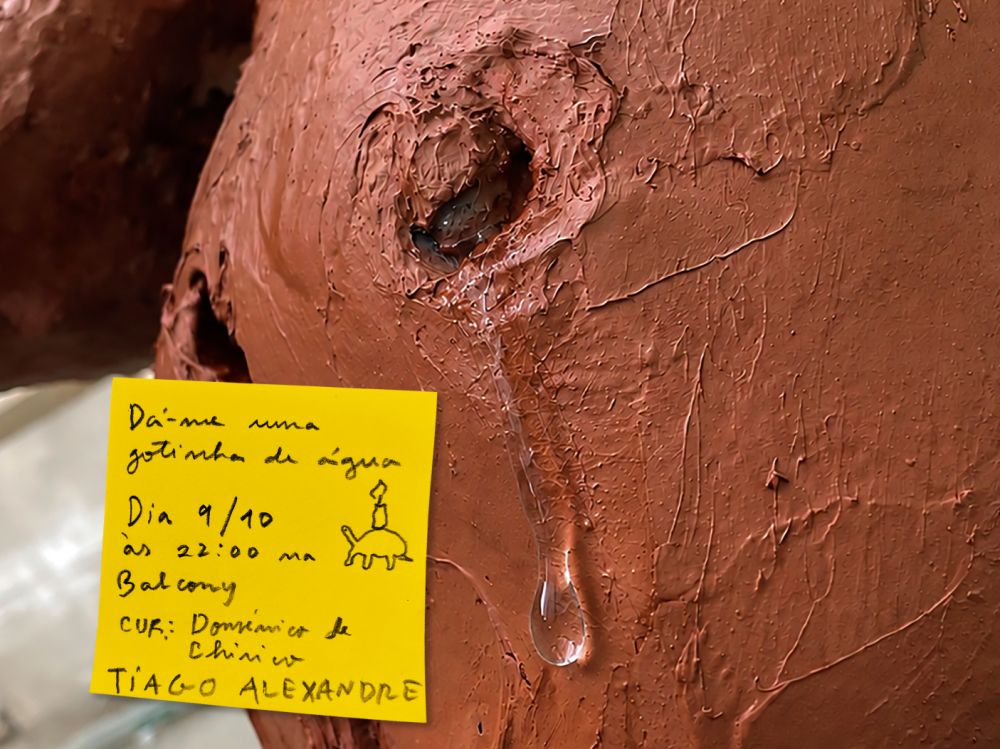
9 Out a 27 Nov 2026
Balcony Gallery
Rua Coronel Bento Roma 12A, Alvalade – Lisboa
Preço
Entrada livre Inauguração: dia 9 de outubro, às 22h00.
"Há uma terra onde a água é escassa, a paisagem vai-se tornando árida sob o domínio da seca e a memória, lentamente, deposita-se como pó sobre a terra. É o Alentejo, região a sul de Portugal, local de origem da família de Tiago Alexandre e onde o artista passou, desde a infância, os seus verões na companhia de um familiar. Pesca, animais, motociclos, lagoas: um universo de experiências que contribuiu para construir um imaginário afetivo destinado a ressurgir muitos anos mais tarde.
Dá-me uma gotinha de água partilha o título com um canto tradicional alentejano. Na sua forma original, a frase é uma espécie de oração dirigida a uma terra árida e sedenta. Na exposição de Tiago Alexandre, porém, o mesmo pedido assume um significado mais íntimo: torna-se a manifestação de uma necessidade de amor, de cuidado, de afeto. Um pedido elementar e, ao mesmo tempo, impossível de ignorar: dá-me pelo menos uma pequena gota.
A prática de Alexandre nasce do entrelaçamento entre experiência, desejo e imaginação e transita livremente entre a escultura, o desenho, o vídeo, a pintura e os objetos. Imagens, situações e fragmentos do dia a dia constituem frequentemente o ponto de partida. Mais do que reproduzi-los, o artista altera a sua percepção para exorcizá-los, observando o que acontece quando são retirados do seu contexto original. Também nesta exposição, elementos aparentemente simples — um animal, um alguidar, uma vela, uma carapaça — tornam-se dispositivos através dos quais o familiar se abre a novas possibilidades de sentido, até compor um canto único , necessário e partilhado.
Neste sentido, a água não é apenas o que falta à paisagem do Alentejo, mas também uma maneira da memória ressurgir. De facto, como sugere o filósofo francês Gaston Bachelard, a água é uma matéria privilegiada da imaginação: não se limita a reflectir o que vivemos, mas transforma-o, tornando-o novamente presente através de imagens, associações e memórias. No seu movimento incessante, na sua capacidade de se insinuar e penetrar, a água encarna o mesmo ritmo da existência: a passagem contínua entre vida e morte, memória e esquecimento, mas também a possibilidade de uma purificação, de uma transformação."
[...]
Texto de Domenico de Chirico
"There is a land where water is scarce, where the landscape parches under the grip of drought, and memory slowly settles like dust upon the earth. This is Alentejo, a region in southern Portugal where Tiago Alexandre’s family originates, and where the artist spent his childhood summers alongside a family member. Fishing, animals, motorcycles, lagoons: a universe of experiences that helped construct an affective imaginary destined to resurface many years later.
Dá-me uma gotinha de água takes its title from a traditional Alentejan folk song. In its original form, the phrase serves as a sort of prayer directed toward an arid land and its thirst for water. In Tiago Alexandre’s exhibition, however, that same plea takes on a more intimate meaning: it becomes the manifestation of a need for love, care, and affection. An elemental request, yet impossible to ignore: give me at least one small drop.
Alexandre’s practice takes shape at the intersection of experience, longing, and imagination, typically spanning sculpture, drawing, video, painting, and found objects. Everyday images, situations, and fragments often serve as his starting point. Rather than simply reproducing them, the artist alters their perception in order to exorcise them, observing what happens when they are displaced from their original context. Across the exhibition, seemingly simple elements — an animal, a basin, a candle, a shell — become vehicles through which the familiar opens up to new layers of meaning, ultimately coming together into a single, necessary, and collective song.
Far beyond a physical thirst in the Alentejan landscape, water functions here as an emotional conduit: the element through which buried memories resurface. As the philosopher Gaston Bachelard suggests, water is a privileged element of the imagination: it does not merely reflect what we have lived, but transforms it, bringing it into the present through images, associations, and recollections. In its restless movement, in its capacity to seep and penetrate, water embodies the very rhythm of existence: the continuous shift between life and death, memory and oblivion, while offering the possibility of purification and rebirth."
Text by Domenico de Chirico
 Divulgue aqui os seus eventos